What Is a Digital Footprint? (And Why Yours Is Bigger Than You Think)
Drash Eldetron
Writes about digital privacy, reputation, and online presence.
August 12, 2026
Most people believe their online presence is just their social media profiles and maybe a LinkedIn page.
The reality is far more extensive—and far less under your control.
Quick overview
- Your digital footprint splits into two layers: what you posted yourself, and a much larger invisible layer of home address, phone number, and records published by others.
- California alone has 578 registered data broker companies collecting and reselling your information — how they get it.
- AI chatbots like ChatGPT and Gemini can now surface your real phone number and address, pulled from the same data-broker sources Google indexes — it’s not just a search-engine problem anymore.
- Four steps to actually reduce what’s out there: audit, opt out, remove from Google, and monitor.
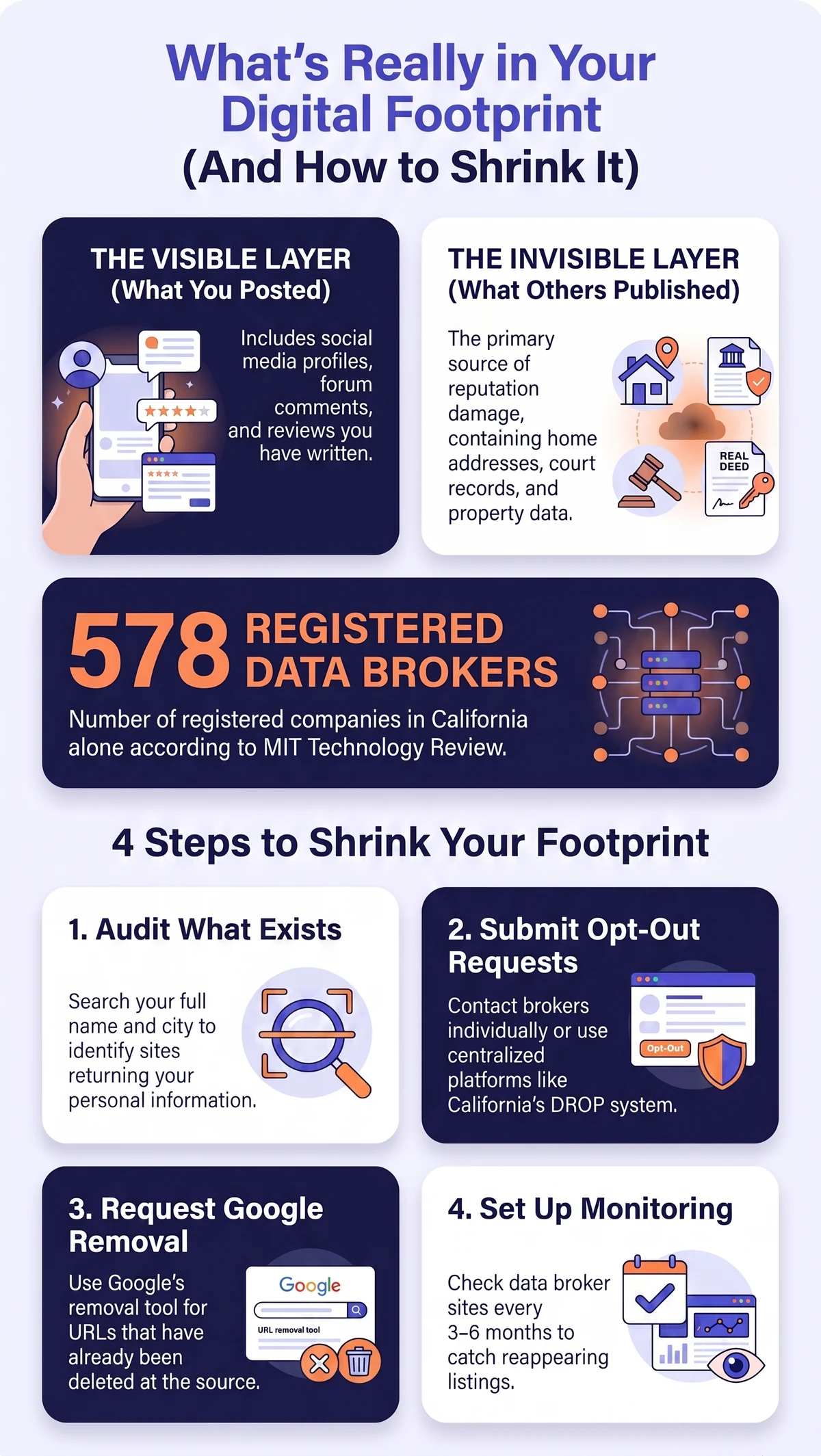
What a digital footprint actually contains
Your digital footprint is everything that appears online when someone searches your name. Much of it was gathered and published without your consent.
The visible layer (things you posted):
- Social media profiles and posts
- Forum comments and Reddit history
- Review you’ve written
- Articles and quotes attributed to you
The invisible layer (things published about you):
- Home address on WhitePages, Spokeo, BeenVerified, and 200+ similar data broker sites
- Phone numbers, email addresses, relatives’ names
- Property records and voter registration data
- Court records, arrest records, bankruptcy filings
- Old cached news articles and archived pages — see our guide to what actually gets a news article removed if one of these is about you
- Reviews others have written about you or your business
- Private or non-consensual images, in the rarer cases where those exist — a separate federal law covers this specifically; see our guide to the TAKE IT DOWN Act
The invisible layer is where most reputation damage comes from—and most people have no idea it exists.
How data brokers collect your information
Data brokers are companies that aggregate public records and sell access to personal data. California’s own data broker registry alone lists 578 registered companies—and that’s one state, and only the ones that registered.
Most are small or irrelevant to an individual search; the ones that actually surface when someone searches your name are a smaller set of consumer-facing people-search sites (WhitePages, Spokeo, BeenVerified, and roughly 100-200 similar sites). They collect from:
- Public government records (voter registration, property records, court filings)
- Social media scraping
- Retail loyalty programs and purchase data
- Other data brokers (they sell to each other)
- Old directory listings and white pages
The result: most new information about a person gets picked up and republished across multiple data broker sites within weeks, often without any single trigger you’d notice.
Why this matters
When someone searches your name—whether it’s a potential employer, a date, a client, or an investor—what comes up in the first two pages effectively defines how they perceive you.
If those results include mugshots, data broker profiles with your home address, or old negative content, the damage is done before you even say hello. Even a court record that’s technically been sealed or expunged doesn’t reliably disappear from this picture — see our guide to why that gap exists.
It’s not just search anymore
AI chatbots have added a new layer to this. Testing by MIT Technology Review found Gemini, ChatGPT, Claude, and Grok all giving out real phone numbers and addresses when asked—sourced partly from data brokers (California’s own broker registry shows dozens of registered brokers admitting they’ve sold data to AI companies) and partly from older web content the models were trained on. EPIC has documented cases of chatbots naming specific people-search sites when asked how to find someone’s address—lowering the barrier for anyone trying to locate a person without their knowledge. Fixing the source page doesn’t always fix what a chatbot says, either — training-based answers can lag well behind the live web; see our guide to why AI can’t simply forget you for that distinction.
The takeaway: reducing what data brokers hold about you isn’t just about controlling your Google results anymore. AI models draw on many of the same sources, so the fewer data broker profiles exist, the less there is for either to surface.
How to reduce your digital footprint
Step 1: Audit what exists
Search your full name, your name + city, your name + employer. Note every site that returns your personal information.
Step 2: Submit opt-out requests
The legal landscape varies by state. Only five states—California, Vermont, Texas, Oregon, and Connecticut—currently require data brokers to register, and just two (California and Connecticut) are building a centralized way to request deletion from every registered broker at once.
California’s Delete Request and Opt-Out Platform (DROP) is furthest along, going live August 1, 2026. Everywhere else, opt-out means a separate request to each broker, on their own form, on their own timeline.
How to read this: state data broker laws are new and still expanding—what’s true today may look different in a year. Check current requirements for your state before assuming a right does or doesn’t apply to you.
Either way, brokers continually re-scrape public records, so removed information tends to reappear over time—a single opt-out round isn’t a permanent fix.
Step 3: Request removal from Google
For specific URLs that should no longer appear in search, Google has a removal request tool. It’s most effective for content that has already been deleted at the source.
Step 4: Set up monitoring
Use Google Alerts for your name, or set up ongoing monitoring so new listings get flagged automatically. Check data broker sites every 3–6 months either way — the battle against data brokers is ongoing.
The professional approach
In the cases I’ve handled, doing this manually and doing it properly—actual opt-out requests, not just editing your own listing—runs about 15 to 25 hours of active work. How long any single request takes to clear varies more than most guides suggest, too: some brokers process it within 24 to 48 hours, others take 30 to 45 days before the listing is actually gone, and there’s no way to know which one you’re dealing with until you submit the request.
It also has to be repeated. In my experience, a first wave of relisted brokers tends to show up around the two-to-four month mark, with a larger second wave from six months on.
Most people hire a service for this. Professional digital footprint reduction services automate the opt-out process, verify removals, and monitor for re-publication—turning that recurring 15-to-25-hour cycle into a managed subscription.
Want to see what’s out there about you? Request a free digital footprint audit from Removacy.
Frequently asked questions
How many states actually require data brokers to register?
Just five — California, Vermont, Texas, Oregon, and Connecticut. Of those, only California and Connecticut are building a centralized way to request deletion from every registered broker at once; everywhere else means a separate opt-out request to each broker.
Have AI chatbots actually pointed people toward tools for finding someone's address?
Yes. EPIC has documented cases of chatbots naming specific people-search sites when asked how to find someone's address, which lowers the barrier for anyone trying to locate a person without their knowledge.
If I successfully opt out of every data broker I can find, is that a permanent fix?
No. Brokers continually re-scrape public records, so removed information tends to reappear over time — a single opt-out round isn't permanent, which is why checking data broker sites every few months matters even after a successful cleanup.
Where do data brokers actually get information about me if I never gave it to them?
Mostly from sources other than you directly: public government records like voter registration, property records, and court filings, social media scraping, retail loyalty programs, other data brokers that sell to each other, and old directory listings.
Prefer not to do this yourself?
We can take it from here
If the steps above don't get you the result you need, tell us what's going on and we'll take a look.
Get in touch