5 Court and Arrest Record Removal Methods That Actually Work
Drash Eldetron
Writes about digital privacy, reputation, and online presence.
September 24, 2026
Most people assume a dismissed charge or a sealed case means the record is gone. It usually isn’t — sealing or expunging the official court file doesn’t reach the copy a site like CaseMine or Instant Checkmate already made before the case closed, and removal requests to these aggregator sites can take up to 60 days to process, depending on the site.
Here's what actually works, method by method.
Quick overview
- Court-record aggregator sites and background-check profiles are two different kinds of listings with two different removal processes — figuring out which one you have comes first.
- Direct removal requests to the aggregator site itself are the standard path, and can take weeks to process depending on the site.
- If Google keeps showing the result even after the source page changes, you can request de-indexing directly — a separate step from removal at the source.
- Sealing or expunging a case is a real legal process, but it doesn’t reach copies already made by these sites before the record was sealed.
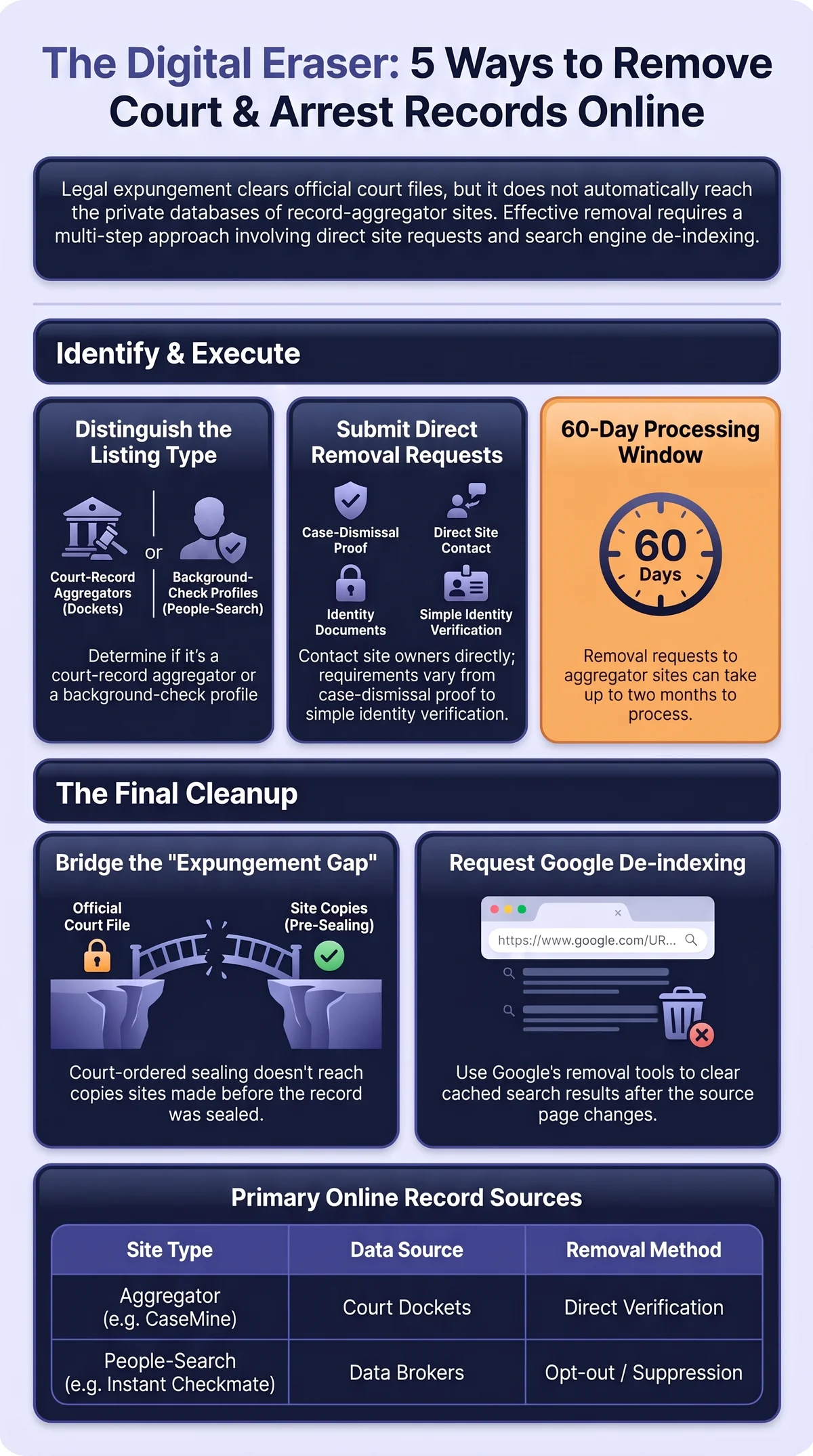
The 5 methods that actually work
1. Figure out which kind of listing you’re looking at
Two different kinds of sites tend to show up when someone searches an arrest or a court case: aggregator sites that republish the actual docket or filing — CaseMine, judyrecords, and similar court-record sites — and background-check or people-search profiles that mention a case as one line item inside a broader report on someone, like Instant Checkmate.
This distinction matters because the removal process is different for each.
A court-record aggregator pulls its listing from an actual case docket, so removal means the site verifying the case’s current status first. A background-check profile pulls from broader data-broker aggregation instead — that’s handled through the site’s opt-out process, not a records request.
2. Request removal directly from the court-record site
If it’s a genuine court-record aggregator, the removal request goes directly to that site — there’s no single central authority that can act on your behalf across all of them. CaseMine and judyrecords are two examples with their own documented process, and we maintain step-by-step guides for these and the rest of the court-record sites we track.
Each site’s exact requirements differ — some want proof the case was dismissed or sealed, others just verify you’re the person named in the record — which is why checking the specific site’s own process matters more than following one generic script.
3. Handle it differently if it’s a background-check profile
If step 1 turned up a background-check or people-search profile instead of a court-record site, the removal process is a data-broker opt-out, not a records request. Instant Checkmate, for example, compiles criminal records alongside contact history and other public data into a single report, and removing that listing means going through its suppression form rather than disputing a court filing.
Confusing the two wastes time — a court-record site generally won’t act on a data-broker-style opt-out request, and vice versa.
4. Ask Google to de-index the result directly
Even after a listing is removed or updated at the source, the cached search result can linger — and a slow or unresponsive site can leave a damaging result visible in the meantime.
Google’s own removal tools let you request that a specific URL be de-indexed directly, separate from whatever the source site does with the page. Our Google De-indexing service covers the exact tools and legal channels for that request.
5. Know what expungement and sealing actually fix
Getting a case sealed or expunged is a real legal outcome — it changes what the official court record shows.
What it doesn’t automatically do is reach a copy an aggregator site already made before the sealing order existed; that copy lives on a separate database the court has no control over. We cover the full mechanism — how a public filing becomes a searchable page, and why the sealed original doesn’t reach it — in our guide to the gap between a sealed record and what Google still shows.
When to get help
Consider bringing in help when you’re dealing with more than one or two listings at once, when a background-check profile and a court-record site are both showing the same case and need two different processes run in parallel, or when a site’s removal request has gone unanswered past its stated timeframe.
Our court record removal service tracks the current process for each site individually, submits and verifies each request, and keeps watching for the record to resurface afterward — which matters, since these listings can get re-generated from the same source data months later.
Dealing with a specific listing right now? Get a free assessment and we’ll tell you exactly what applies to your situation.
Frequently asked questions
How long does a court-record removal request typically take?
It varies by site — anywhere from a few days to roughly two months. Sites that primarily republish court dockets tend to move on the slower end of that range, since removal usually means verifying the case status before they'll act, rather than an automated opt-out.
Is it actually legal for these sites to publish court records and arrest information?
Generally, yes. Court records are public by default in the US unless a specific case has been sealed or expunged, and republishing already-public information is broadly protected. That's exactly why removal has to go through each site's own process rather than a general legal takedown.
If one site removes my listing, will other similar sites still have it?
Usually. Each aggregator builds its own database, often from the same underlying court or broker source, but removing a listing from one doesn't notify or affect the others. Each site that has a copy needs its own separate removal request.
Do paid "record removal" or mugshot cleanup services actually work?
Some do legitimate removal work, but the space also has predatory operators — sites that profit from publishing the record in the first place, then charge a fee to take it down. Worth checking whether a service is removing a listing or just working around one it helped create.
Prefer not to do this yourself?
We can take it from here
If the steps above don't get you the result you need, tell us what's going on and we'll take a look.
Get in touch